
How Can Counselling Help With Stress?
For many adults, stress has a way of quietly weaving itself into daily life. It may show up in busy mornings, restless nights, or a constant sense of needing to keep going. Often, it is not caused by one dramatic event, but by the steady accumulation of responsibilities, expectations, and uncertainty. For some people, counselling support can help by providing a space and time to look at what’s going on in your life. A counsellor can help you to explore what’s creating the symptoms of stress you’re experiencing, and help you to work out what you need to help you feel more relaxed and grounded.
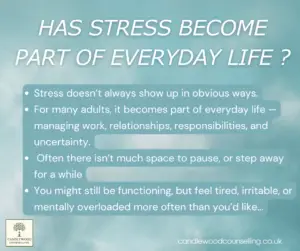
When Stress Becomes Part of Everyday Life
Stress is a common human experience, particularly in modern life. Yet many people feel they should simply cope with it, push through, or not make too much of a fuss. Over time, this can leave individuals feeling worn down, disconnected, or unsure why things feel harder than they used to. Understanding stress — and recognising when it may help to seek support — can be an important first step towards feeling more balanced again.
What Is Stress?
Stress is the mind and body’s natural response to pressure or challenge. When something feels demanding or threatening, the body prepares to respond by releasing stress hormones. In short bursts, this response can be helpful. It can sharpen focus, increase energy, and support problem-solving.
Short-Term Stress V's Ongoing Stress
Difficulties can arise when stress becomes ongoing. Instead of switching off once a situation has passed, the body remains in a heightened state of alert. Over time, this can feel exhausting and overwhelming, particularly if there is little opportunity to rest, reflect, or feel supported. Ongoing stress is not a sign of weakness; it is often a sign that too much has been carried for too long.
Common Causes of Stress in Adult Life
Stress does not have a single cause, and what feels stressful can vary greatly from person to person. For some, work pressure or job insecurity plays a central role. For others, finances, relationship difficulties, caring responsibilities, or health concerns may weigh heavily.
Life changes can also be stressful, even when they are expected or positive. Moving home, becoming a parent, changes in identity or role, and periods of uncertainty can all place strain on emotional resources. In wider society, ongoing news cycles, economic pressures, and a sense of unpredictability can quietly add to the load many adults are already carrying.
It is important to recognise that stress is personal. What one person finds manageable, another may find deeply challenging. There is no “right” level of stress, and comparison often makes it harder to acknowledge one’s own needs.
How Stress Can Affect Us
Stress can influence emotional wellbeing, physical health, and day-to-day functioning in subtle and not-so-subtle ways
Emotional and Physical Effects of Stress
Emotionally, people may notice increased irritability, anxiety, low mood, or a sense of numbness. Physically, stress can contribute to fatigue, muscle tension, headaches, or changes in sleep and appetite.
How Stress Can Affect Thinking and Behaviour
Stress can also affect how people think. Concentration may become harder, decision-making more effortful, and worries more repetitive. Some individuals find themselves withdrawing from others or losing interest in activities they once enjoyed. These responses are understandable reactions to prolonged pressure, not personal shortcomings or failures to cope.
Why Stress Can Feel Hard to Talk About
Despite how common stress is, many adults find it difficult to speak openly about it. Some minimise their experience, telling themselves that others have it worse or that they should be grateful. Others worry about being a burden or feel unsure how to put their feelings into words.
There can also be a belief that stress is simply part of adult life and must be endured. Over time, this can lead to isolation, where people carry their worries privately and feel increasingly alone with them. These hesitations make sense. They often reflect long-held messages about coping, resilience, and self-reliance.
How Counselling Can Help
Counselling offers a confidential and supportive space to talk about stress without judgement or pressure to have everything figured out. It is not about being told what to do or having problems “fixed”. Instead, it is a collaborative process that helps people explore what they are experiencing and why it feels the way it does.
Counselling does not require someone to be in crisis. It can be a supportive step at any point where stress feels heavy, confusing, or persistent.
What Stress Counselling Can Offer
For some, stress counselling provides an opportunity to slow down and make sense of patterns that have developed over time. For others, it can help build practical ways of responding differently to pressure, boundaries, or expectations. Many people also find relief simply in being listened to and understood, rather than having to hold everything together on their own.
Taking a Moment to Reflect
It may be helpful to pause for a moment and notice how stress shows up in your own life. Is there space to rest, or does it feel as though you are always pushing through? Are there feelings or worries that rarely get spoken aloud?
Taking a few slow breaths and gently noticing what feels present can sometimes bring clarity. Even brief moments of reflection can help reconnect with what is needed, rather than what is expected.
Support for Stress in Newton Abbot and Beyond
Living with ongoing stress can feel draining, but it does not have to be faced alone. Support for stress is available, and many adults find that talking things through brings relief, understanding, and a renewed sense of balance over time.
Whether through counselling or other supportive conversations, acknowledging stress is not a failure. It is often a meaningful act of self-care. Change does not need to be dramatic to be valuable; sometimes it begins with being heard and understood.
Common Questions About Stress and Counselling (FAQ)
Do I need counselling if I’m feeling stressed but still coping?
Many people seek counselling while continuing to manage work and daily responsibilities. Counselling can offer space to explore stress before it becomes overwhelming.
How can counselling help with ongoing stress?
Counselling provides a confidential space to talk through what is contributing to stress, notice patterns, and develop more supportive ways of responding to pressure.
Is stress counselling only for severe stress or burnout?
No. Stress counselling can be helpful at many stages, including when stress feels manageable but persistent, confusing, or emotionally draining.
Will counselling give me techniques to manage stress?
Some people find practical strategies helpful, while others value having time to reflect and be understood. Counselling is shaped around individual needs rather than a fixed approach.
How long does counselling for stress usually last?
This varies from person to person. Some find short-term support helpful, while others choose longer-term counselling depending on what they are experiencing.
Sources and further reading (UK-based):
- NHS – Read guidance on stress from the NHS: https://www.nhs.uk/mental-health/feelings-symptoms-behaviours/stress/
- Mind – Read more about Understanding stress from MIND: https://www.mind.org.uk/information-support/types-of-mental-health-problems/stress/
- British Association for Counselling and Psychotherapy (BACP) – Answer to the question ‘What is counselling?’: https://www.bacp.co.uk/about-therapy/what-is-counselling/
- Mental Health Foundation –Read more about the effects of stress: https://www.mentalhealth.org.uk/explore-mental-health/a-z-topics/stress
If you’re looking to untangle challenges your facing and find a path to firmer ground, I offer a counselling in a space that’s professional but human, gentle but honest. Find out more about how I work on the About page and Counselling Services Stress page. Or get in touch on Whatsapp

Samantha@ Candlewood Counselling | Counselling in Newton Abbot (TQ12) and online. Contact Samantha here
Samantha Martin | Counsellor | MBACP | MNCPS ( Accred.)