
How Can Counselling Help With Stress?
Stress can quietly creep up on adults without us noticing at first. Perhaps you start to recognise it in the busy mornings and frazzled evenings. Or maybe it’s when you realise that you feel like you constantly need to ‘keep going’. For some people stress creeps in gradually; not necessarily caused by one huge life event, but by a constant drip-drip of responsibilities, expectations and ‘what ifs’.
Counselling support can help by allowing you some time and space to explore what’s going on in your life. A counsellor can help you look at what’s causing the symptoms you’re experiencing, and then help you work out what you need to feel more relaxed.
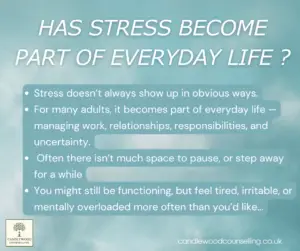
When Stress Becomes Part of Everyday Life
Stress is part of life. But when it becomes part of your everyday experience, it can start to impact how you feel and function. Many of us believe we just have to ‘cope’ with stress, but never take time to unravel it. We may then start to feel worn down, disconnected from others or find themselves wondering why things have suddenly become more difficult. Looking at stress — and when it might be helpful to talk to someone — is often the first step to feeling more like yourself again. of a fuss. Over time, this can leave individuals feeling worn down, disconnected, or unsure why things feel harder than they used to. Understanding stress — and recognising when it may help to seek support — can be an important first step towards feeling more balanced again.
What Is Stress?
When we experience stress, it’s the body and mind’s response to pressure. When something feels challenging or threatening, the body releases stress hormones. This can cause physical and mental changes that help us cope.
For example, short bursts of stress can help us focus, feel energised and help us problem solve.
This stress response is temporary, and the body is designed to return to normal once a stressful situation has passed.
Short-Term Stress V's Ongoing Stress
The trouble with stress sometimes is that it doesn’t always go away. If we experience ongoing challenges without regular relief, stressors can continue impacting on our thoughts, emotions and bodies.
The effects of short-term stress generally ‘switch-off’ once a situation is resolved. We might feel exhausted after a short period of time, but usually return to our day-to-day selves once it has passed.
Ongoing stress, on the other hand, can leave us feeling tired, overwhelmed, anxious and irritable. Constant stress can occur if there is little opportunity to unwind, refuel or feel emotionally supported.
Ongoing stress is not something we should just learn to live with. It’s a sign that too much pressure has been building for too long.
What Are the Causes of Stress?
When it comes to causes of stress, there’s no typical answer. For some, pressures at work or concern over job stability can contribute to their experience. For others, it may be financial pressures, relationship problems, caring responsibilities or health problems.
Stress can also arise from changes in our lives, even when these are expected or positive. Becoming a parent, moving house, feeling uncertainty about your identity or life role. Some people are impacted by the constant news cycles, speaking of troubling world events; societal pressures, and uncertainty about the future can weigh heavily on the mind.
It’s also important to remember that stress feels different for everyone. Some people can cope with many stressors while others can feel overwhelmed by small changes. Only you can determine whether your stress feels manageable, so it can sometimes be unhelpful to compare your stress levels to others.
How Does Stress Affect You?
Stress affects people in many ways. Some of the physical and emotional effects of stress are subtle, others less-so.
Emotional and Physical Effects of Stress
Stress can impact our emotions and mood. Many people find they feel more irritable, anxious, ‘down’ or numb.
Physically, stress can manifest as tiredness, muscle tension, headaches or changes to our sleep and appetite.
How Stress Can Affect Thinking and Behaviour
Many people also notice a change to how stress affects their thinking. It can make concentration difficult, decisions feel laboured and worries begin to feel repetitive. You may find yourself withdrawing from loved ones or losing interest in activities that used to bring you joy.
All of these reactions are normal responses to stress, not personal weaknesses or failure to deal with life’s difficulties.
Why Stress Can Feel Hard to Talk About
Stress is something many adults experience, but it’s also something that can be difficult to talk about. Some people dismiss their stress, convincing themselves that others have it worse. Others believe talking about stress will make them a burden to loved ones.
There can also be a sense that stress is just ‘adulting’ and we all have to deal with it. But when we don’t talk about stress, we can end up isolated with our problems, perhaps feeling that we just have to ‘get on with it’ or that it’s not bad enough to ask for help with.
These feelings are valid and understandable. Many are based on messages we learn over time about what it means to ‘cope’.
How Counselling Can Help with Stress
Counselling gives you space to talk openly about stress. You won’t be judged or expected to have all the answers. Counselling isn’t about being told what to do. Instead, counsellors support you to explore what you’re experiencing. Talking things through can help you understand why you’re feeling the way you do.
Counselling isn’t just for when you’ve reached crisis point. If stress is weighing you down, counselling can provide support at any stage.
What Stress Counselling Can Offer
Some people find counselling helps them untangle complicated situations and look at what’s going on from a different perspective. Others find it helps them learn how to say no or prioritise their own needs.
Often, people experience counselling as simply feeling heard. Having someone listen without judgement and help you find some ways forward can help you feel less alone with your stress.
Taking a Moment to Reflect
Try taking a moment to think about how stress affects you. When was the last time you had time to sit and relax? Is there anything you’ve felt unable to talk about?
Take a few deep breaths and notice what comes up for you. Sometimes pause can help you connect with what you need, rather than what you think you should feel.
Support for Stress in Newton Abbot and Beyond
Stress doesn’t have to be something you fight on your own.
Talking to someone about stress can bring small moments of relief. Over time, support can help you gain more understanding of your stress. You can begin to find your balance again.
Talking to someone about stress isn’t a sign of weakness. Quite the opposite; taking care of your mental health is an important part of taking care of yourself.
If you’re looking to work through the pressures and challenges you’re facing, and find a path to firmer ground, I offer a counselling in a space that’s professional but human, gentle but honest. Find out more about how I work on the About page and Counselling Services Stress page.
Or get in touch on Whatsapp

Common Questions About Stress and Counselling (FAQ)
Do I need counselling if I’m feeling stressed but still coping?
Many people make use of counselling services whilst continuing to work or looking after their home life. Counselling can give you the space to explore your stress before things become unmanageable.
Can counselling help with ongoing stress?
Yes! Counselling offers a safe, confidential space to talk through stressors. It can help you notice patterns and respond to stress in more helpful ways.
Is stress counselling only for severe stress or burnout?
No. Stress counselling can be beneficial at various stages of stress. Even if you feel like you’re coping, counselling can offer support if stress feels heavy, persistent or draining.
Will counselling give me techniques to manage stress?
Everyone is different, and as therapists we recognise this. Some clients will benefit from learning specific techniques to manage stress. However, it can also be helpful to take time to reflect on where the problems began, how they’ve evolved and perhaps what needs to change. Counselling is shaped around your needs.
How long does counselling for stress usually last?
This will vary from client to client. Some people prefer short-term support, others use counselling longer term, based on what they are experiencing and what they want to get out of their counselling sessions. We’ll regularly review our work to make sure you feel it’s heading in the right direction.
Sources and further reading (UK-based):
- NHS – Read guidance on stress from the NHS: https://www.nhs.uk/mental-health/feelings-symptoms-behaviours/stress/
- Mind – Read more about Understanding stress from MIND: https://www.mind.org.uk/information-support/types-of-mental-health-problems/stress/
- British Association for Counselling and Psychotherapy (BACP) – Answer to the question ‘What is counselling?’: https://www.bacp.co.uk/about-therapy/what-is-counselling/
- Mental Health Foundation –Read more about the effects of stress: https://www.mentalhealth.org.uk/explore-mental-health/a-z-topics/stress
Samantha@ Candlewood Counselling | Counselling in Newton Abbot (TQ12) and online. Contact Samantha here
Samantha Martin | Counsellor | MBACP | MNCPS ( Accred.)