
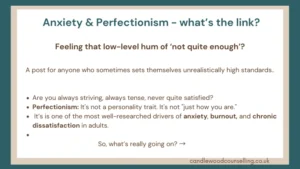
When 'doing well' creates anxiety- Perfectionism
There’s a type of anxiety that does not typically show up as anxiety.
Cloaked externally in achievement, it seems more like ‘putting in the effort’. More like being conscientious. Like being a person who cares about doing things right. It rewards you with praise at work. Respect from your colleagues. A reputation for being dependable. But internally it can feel anything but positive or relaxing. More like a hum in your brain that says ‘it’s not enough’ and that no amount of achievement quite silences.
You worry a lot about doing things perfectly and making mistakes. Maybe you don’t really experience pleasure in your success.
Sound familiar? If you’ve ever wondered whether this feeling could have a clinical explanation — or worried about how its affecting your life and how to effectively treat it — then this is a post for you.
What Is Perfectionism?
Perfectionism isn’t technically a mental health diagnosis. But it is a well-defined psychological concept with clear implications for mental health.
Lead researcher Shafran from the University of Oxford defines clinical perfectionism as overreliance on “the determined pursuit of personally demanding, self-imposed standards in at least one highly valued domain, despite adverse consequences.”
Three points from this definition are worth thinking about:
1. Self-imposed. The standards that appear in your mind are standards you’ve chosen for yourself. Usually standards you would never hold anyone else to so rigorously.
2. Your sense of self worth depends on meeting those standards. There is no floor. Once perfectionism has a grip, you cannot merely “be okay” you have to prove you’re okay.
3. Despite adverse consequences. One of perfectionism’s defining features is how it ignores feedback from your own life. Even when it’s causing distress — to your health, your relationships, your ability to relax or enjoy yourself — your inner critic knows to keep pushing you.
The Perfectionism–Anxiety Connection
Perfectionism’s relationship to anxiety is well documented.
A 2023 literature review published in Cognitive Behaviour Therapy (416 studies with 113,000 participants), found strong links between perfectionism and depression, generalised anxiety, social anxiety, and OCD symptoms.
So it’s not only that perfectionism co-exists with anxiety disorders. They actively feed into each other:
Hyper-alertness to threat. Anxiety depends on perceived threat. If your whole identity depends on performing, then any situation where you will be evaluated (including by yourself) becomes a threat. Chronic physiological arousal becomes your body’s way of responding to that threat — not panic attacks necessarily but struggling to relax, feeling “on edge” and having trouble switching off.
Rumination. Mistake rumination (continually going over things you perceive you did wrong) is a proven pathway between perfectionism and both anxiety and depression. Perfectionists just can’t let go.
Avoidance. Similarly, perfectionism often causes us to procrastinate, not because we don’t want to do the work but because we don’t want to begin or finish a task where there is any risk we won’t meet the standards we’ve set. The temporary reduction in anxiety we get from putting off something important reinforces the belief that we need to be perfect to face it.
Intolerance of uncertainty Perfectionism and anxiety are both fundamentally made worse by uncertainty. When things feel unpredictable or unstable, the effort, the checking, the over-preparation makes us feel safer. Except it doesn’t.
Three Types of Perfectionism — and Why They Matter
Perfectionism is commonly divided into three distinct categories:
● Self-oriented perfectionism is when your high standards apply to yourself.
● Other-oriented perfectionism is when your high standards are applied to other people.
● Socially prescribed perfectionism is when you believe others hold high standards of you.
Each can generate anxiety, but they present differently.
Research finds that self-oriented perfectionism is primarily associated with performance anxiety and depression, particularly when you experience failure. People with high other-oriented perfectionism tend to experience their anxiety through aggression, frustration, or being let down by others.
Socially prescribed perfectionism — generally agreed to be the most damaging to mental health — is when we take others’ expectations as our own, feeling overwhelming pressure to achieve and live up to them.
Studies consistently link it to social anxiety and fear of not belonging. Socially prescribed perfectionism was one of the only types of perfectionism that increased between 1989 and 2016, mainly due to pressure to conform and social comparison, driven by increases in income inequality.
Why Perfectionism Develops
Perfectionism isn’t something you “chose” to do, a flaw in your character or a way of behaving you’ve decided is beneficial. You develop perfectionism because of some combination of factors in your life.
Most research on perfectionism points to early life experiences, particularly where support or acceptance was conditioned on achievement or behaviour. Imagine if, as a child, your parents only loved you when you got good grades or behaved how they wanted. It would stand to reason that becoming perfect would become your number one goal.
That kind of anxiety about not being good enough is logical when it develops — and so is the anxiety it provokes when you fail to live up to ‘perfect’ standards.
The relationship between attachment styles and perfectionism is also widely recognised. In particular, insecure attachment styles (especially anxious attachment) correlate with high perfectionism and low self-compassion.
The problem is self-reinforcing. The more someone struggles with perfectionism the lower their self-compassion becomes.
Why Perfectionism is Difficult to Shift
One of the reasons perfectionism is difficult to shift without support is that it is self-reinforcing. When an outcome is ok, you can come to the conclusion that the effort was necessary, not that it cost you too much. The belief is reinforced. You raise the bar. The cycle continues.
When the outcome isn’t satisfactory, the self-critical response activates, driving further striving, effort and further anxiety. You’re stuck in the cycle.
Seeking Help
Many people living with perfectionism wait a long time before seeking support — in part because perfectionism makes it difficult to feel that the situation is “bad enough” to justify asking for help. There is often a nagging feeling that the solution lies in ‘just trying harder, managing better, or finally getting things right’.
If any of what you have read here feels familiar — an anxiety that no amount of rest seems to fix, the feeling of satisfaction that never quite lands, or thequiet cost to your relationships and wellbeing — it may be worth speaking to a counsellor. Counselling can help by:
- Exploring your ‘internal core beliefs’ – understanding why these high standards exist, what they protect, and what they cost
- Broadening your self-evaluation: developing a more stable sense of self-worth that doesn’t depend on your ‘performance’
- Testing whether the feared consequences of your ‘imperfection’ actually happen
- Noticing the self-critical voice and developing a more accurate and compassionate response to yourself.
For more information about how I can help if you’re feeling stressed, visit my counselling for stress page, or read my post about stress here.
To Get in Touch
If you’re looking to to understand what is driving the anxiety, and to build a therapeutic relationship that does not depend on what you achieve, you could contact me at Candlewood Counselling. Based in Newton Abbot and available online, I offer counselling that’s professional but human, gentle but honest, in a confidential, grounded space.
Find out more about me on the ‘About’ page to see if I sound like the right counsellor for you, or visit my Counselling Services page.
Feel free get in touch below on Whatsapp.

Samantha@ Candlewood Counselling | Counselling in Newton Abbot (TQ12) and online. Contact Samantha here
Samantha Martin | Counsellor | MBACP | MNCPS ( Accred.)